Introducing Synkora: The Open-Source AI Agent Platform Your Team Actually Owns
Most AI teams do not fail in the demo.
They fail the week after the demo, when a clever prompt suddenly needs tenants, permissions, billing, channels, queues, retries, analytics, and a UI that normal people can actually use.
That is the moment Synkora was built for.
Synkora is built for the part of AI work that starts after the first impressive response.
The Problem We Kept Seeing
The pattern was always the same.
A team would build something promising with an LLM in a few hours. A support bot. A research assistant. A data copilot. A workflow agent. The first version looked magical.
Then reality arrived:
- Where does conversation history live?
- How do you connect the model to internal knowledge?
- How do you keep one customer from seeing another customer's data?
- How do you ship the same agent to Slack, WhatsApp, Teams, Telegram, and the web without rebuilding the whole thing five times?
- How do you track usage, cost, failures, retries, and permissions?
- How do you let a real company own its infrastructure and models instead of handing everything to another black box?
Most tools in the market solve a slice of that. A framework gives you primitives. A workflow tool gives you blocks. A chatbot tool gives you a single surface.
We wanted the missing layer: the full platform.
So We Built Synkora
Synkora is an open-source, multi-tenant, API-first platform for building, deploying, and operating AI agents.
Not a prompt playground.
Not a narrow chatbot builder.
Not glue code you still have to turn into a product later.
Synkora gives teams a real control plane for agents:
- A web UI for creating and managing agents
- Multi-tenant workspaces with isolation, quotas, and API keys
- RAG knowledge bases with pluggable vector backends
- Tooling, integrations, and MCP server support
- Multi-channel deployment across Slack, WhatsApp, Teams, Telegram, web widget, and REST API
- Billing, scheduled tasks, and observability built in
- Self-hosting with your own infrastructure and your own LLM keys
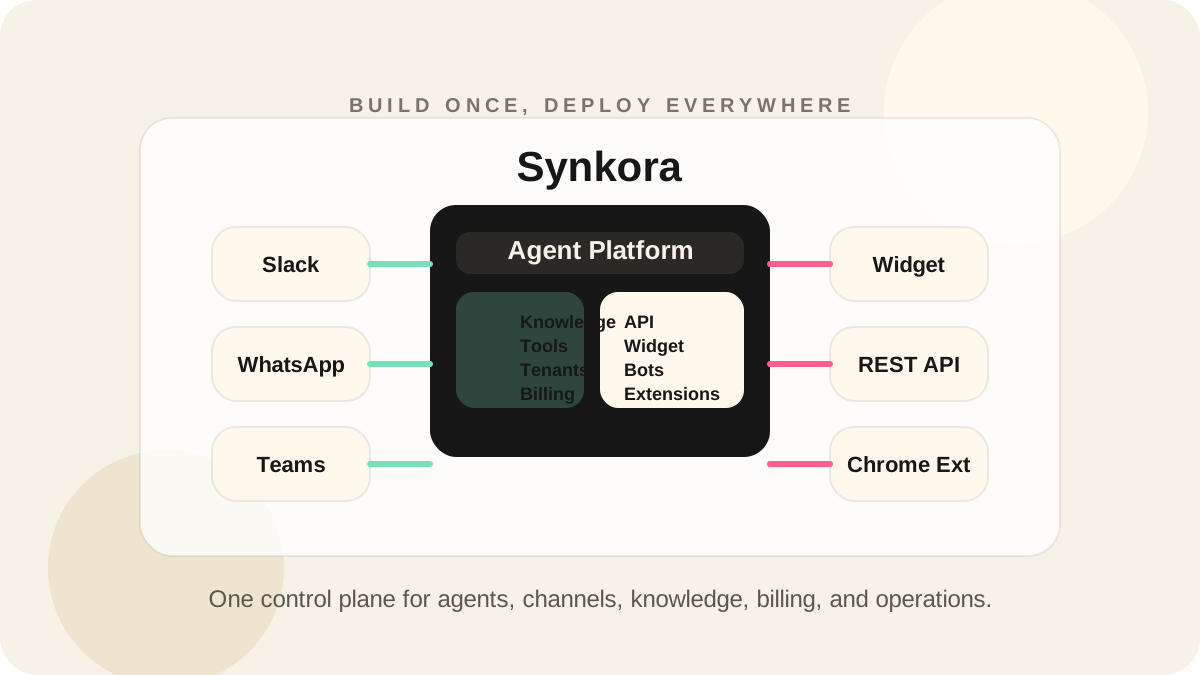
One platform in the middle. Many places your agents can actually live.
What Synkora Looks Like Today
We designed Synkora for the way real teams ship.
1. Platform, not framework
You do not start with an empty repo and a pile of abstractions. You start with a system that already understands agents, tenants, channels, knowledge bases, billing, and operations.
That distinction matters more than it sounds.
When a product team says, "we need an internal AI assistant," they are usually not asking for a bag of libraries. They are asking for something they can launch, control, audit, and evolve.
2. Multi-tenant from day one
Multi-tenancy is not an afterthought in Synkora. It is part of the foundation. Agents, credentials, usage, and limits are designed around the reality that one platform often serves many teams, departments, customers, or workspaces.
That makes Synkora usable both as:
- a cloud platform
- a self-hosted deployment for a single organization
- an internal platform team’s shared agent layer
3. Bring your own model stack
Synkora uses LiteLLM so teams can route across OpenAI, Anthropic, Google, and other model providers without hard-locking the platform to one vendor.
That means you can change providers without rebuilding your entire application surface.
4. Real delivery surfaces
Agents are only useful if they show up where work is already happening.
Synkora already supports the surfaces teams care about most:
- Slack
- Microsoft Teams
- Telegram
- embeddable web widget
- REST API
And inside the repo, we are already expanding that surface area further with a Chrome extension and a Flutter chat SDK, because agents should not be trapped in one UI shell.
5. Built for operations, not just conversations
The platform already includes the unglamorous parts that separate prototypes from products:
- Redis-backed coordination and caching
- Celery queues for background processing
- scheduled jobs
- billing and usage tracking
- Langfuse observability
- browser automation and scraping services
- storage, vector backends, and tenant-aware APIs
The Shape of the System
A good AI platform should feel simple at the top and disciplined underneath.
That is how we approached Synkora.
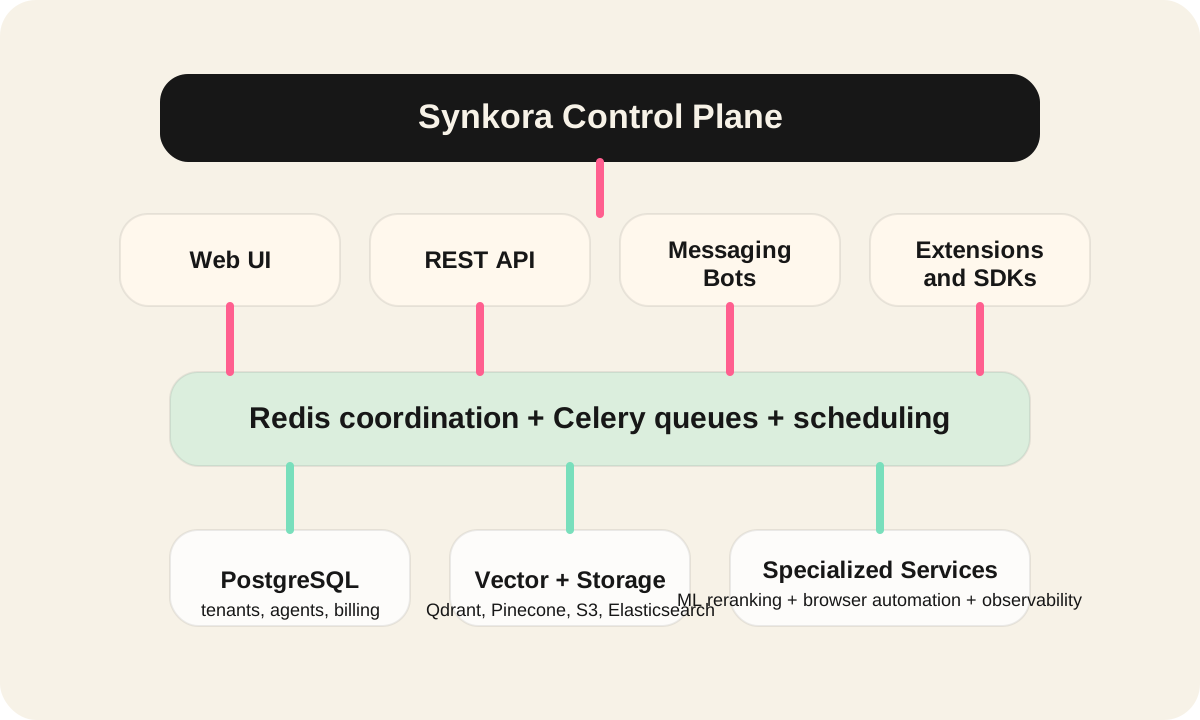
Stateless control plane on top, coordinated execution in the middle, durable systems underneath.
At the top, teams interact through the dashboard, APIs, bots, widgets, and extension-style surfaces.
In the middle, Redis and Celery handle the coordination that production systems need: cache invalidation, real-time updates, retries, schedules, queue separation, and background work.
Underneath, PostgreSQL holds the system of record, vector and storage providers back knowledge workflows, and specialized services handle things like reranking and browser automation.
That architecture lets Synkora support more than "chat with a model." It supports actual agent products.
Why Open Source Matters Here
We think infrastructure for AI applications should be ownable.
That means:
- MIT licensed
- self-hostable
- no hard dependency on our keys
- no forced vendor lock-in
- no requirement to hand over your customers, prompts, and operations to a black box
If your company wants to run agents in its own environment, with its own controls and its own compliance posture, that should be normal, not a premium exception.
What We Want People To Build With It
We built Synkora for teams shipping things that actually touch work:
- customer support agents with RAG and human escalation
- engineering assistants connected to GitHub, GitLab, or Sentry
- internal copilots for HR, finance, and operations
- data agents for natural-language access to business systems
- marketing systems that draft, review, and distribute content
- personal assistants with voice, browser control, and messaging interfaces
The point is not "look, an AI demo."
The point is: you can build one agent platform once, then keep extending it without redoing your foundation every quarter.
This Is Just The Beginning
Synkora already spans the dashboard, APIs, knowledge bases, billing, messaging channels, browser automation, observability, and self-hosted deployment story.
But the larger ambition is even simpler:
We want building an AI product to feel less like stitching together ten fragile services and more like standing on a platform that is already ready for production.
If that is the layer you have been missing, start with the Quick Start Guide and explore the documentation.